
About The Book
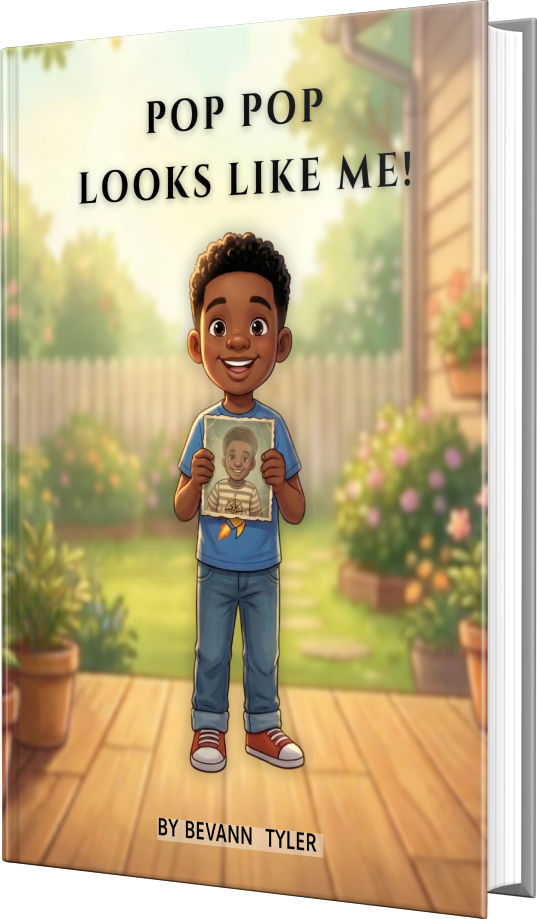
Pop Pop Looks Like Me !
‘Pop Pop Looks Like Me’ opens on a rainy Saturday morning with six year old Evan writing his grandfather’s name on the foggy kitchen window. PopPop is coming to visit, and Evan can barely contain his excitement. The kitchen fills with breakfast smells as Evan sits with his family, holding tight to a photograph his mother gave him. The picture shows a young boy who looks exactly like Evan, and he believes with complete certainty that this is what PopPop looks like.
When his friends Aidan and Abner arrive to play, Evan proudly shows them the photograph. The twins have brought a baby turtle named Turbo, and excitement builds until a disagreement leads to Aidan tearing the picture in half. Evan feels betrayed and storms to his room, upset about the damaged photograph and feeling that nobody understands how important it is.
Then PopPop arrives. Evan rushes to meet him and stops cold. The man at the door is elderly, using a walker, carrying an old suitcase. This is not the boy from the photograph. This cannot be his PopPop. Evan’s joy crashes into confusion and disappointment. He throws a tantrum, insisting this old man cannot be his twin, cannot play with him, cannot be who Evan expected. He retreats to his room in tears, feeling betrayed by reality itself.
His mother comes to comfort him, gently explaining that PopPop looked like that photograph when he was younger, just as Evan looks like it now. People grow older, she tells him, but they are still themselves. When Evan finally sits with PopPop, his grandfather shows him another photograph, this one of PopPop as a baby. In that moment, Evan begins to understand. They share more than appearance. They share family, history, and love that does not change even when bodies do.
Pop Pop Looks Like Me !
‘Pop Pop Looks Like Me’ addresses a challenge many children face: understanding that the people they love change over time. Young children often struggle with the concept that their grandparents were once young, that the elderly person before them was once a child who played and laughed and looked different. This book provides a gentle entry point for that conversation, using a relatable story to help children grasp something abstract.
The book works because it respects children’s emotions. Evan’s disappointment and confusion are treated seriously, not dismissed as silly. His tantrum is understood as genuine distress rather than bad behavior. The story acknowledges that learning people are not what we imagine can be difficult, and it gives Evan space to feel upset before he can accept the truth. Parents and caregivers will appreciate this approach because it models how to handle these moments with empathy rather than frustration.
For families with young children meeting older relatives, especially grandparents or great grandparents, this book offers preparation. It opens dialogue about aging, appearance, and identity in ways that make sense to children. The photographs in the story provide a concrete tool families can use in their own conversations, encouraging children to look at old family photos and see connections between generations.